Insoluble Dietary Fibres Market Overview
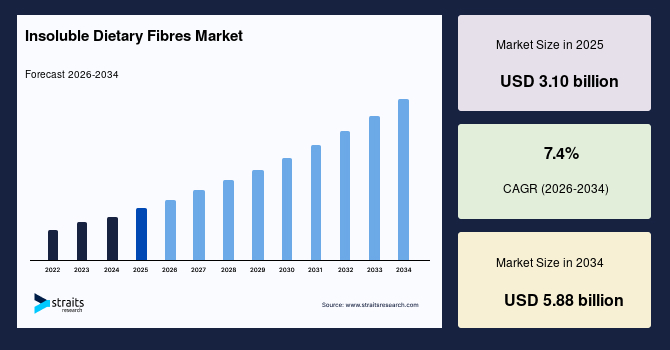
The global insoluble dietary fibres market size is valued at USD 3.10 billion in 2025 and is estimated to reach USD 5.88 billion by 2034, growing at a CAGR of 7.40% during the forecast period. The market growth is primarily driven by rising consumer awareness of digestive wellness and increasing global demand for functional, high-fibre foods and supplements. Additionally, the market is boosted by public health policies, such as sugar taxes and clear labelling rules, which encourage manufacturers to reduce sugar and fortify staple products with fibre for texture and bulk.
Key Market Trends & Insights
- North America dominated the market with a revenue share of 39.7% in 2025.
- Asia Pacific is anticipated to grow at the fastest CAGR of 11.8% during the forecast period.
- Based on ingredient type, the Cereal and grain fibres segment held the highest market share of 34.5% in 2025.
- By application, the Snacks and barssegment is estimated to register the fastest CAGR growth of 9.5%.
- Based on form, the Standard milled powderscategory dominated the market in 2025 with a revenue share of 58%.
- Based on end user, the Nutrition and sports brandssegment is projected to register the fastest CAGR of 9.0% during the forecast period.
- U.S. dominates the market, valued at USD 782.88 million in 2024 and reaching USD 837.45 million in 2025.
Table: U.S. Insoluble Dietary Fibres Market Size (USD Million)

Source: Straits Research
Market Size & Forecast
- 2025 Market Size: USD 3.10 billion
- 2034 Projected Market Size: USD 5.88 billion
- CAGR (2026-2034): 7.40%
- Dominating Region: North America
- Fastest-Growing Region: Asia Pacific
The insoluble dietary fibres market includes ingredients such as wheat, oat, and corn fibres, fruit and vegetable fibres, cellulose, and resistant starches. These are widely used in bakery items, cereals, snacks, pasta, plant-based dairy alternatives, and nutrition bars. The global fibre intake gap influences demand, as most adults consume only 15–18 g/day, compared to the recommended 25–30 g/day, driving the need for fibre-fortified staple foods. Regulatory clarity also supports growth.
Latest Market Trends
Policy-driven reformulation boosts fibre fortification
Public health policies are pushing food and beverage brands to increase fibre and reduce sugar content. With most adults falling short of the WHO’s 25g daily fibre recommendation, fortified staples like cereals, bread, and snacks are gaining traction. Front-of-pack nutrition labels in markets like Canada and sugar-based taxes in regions like the UAE motivate brands to replace sugars with fibre-rich ingredients. As labels tighten and reformulation accelerates, demand is rising for application-specific fibre grades that maintain product quality while enabling "high-fibre" and “reduced sugar” claims.
Application-ready fibre systems improve sensory outcomes
A notable trend is the growing use of refined, application-ready insoluble fibre ingredients that make reformulation easier. Products like VITACEL wheat/oat fibres, HI-MAIZE resistant starch, and Fibersym RS4 are available with precise water-binding, particle-size, and processing data. These systems enable brands to enhance fibre content without compromising texture, taste, or processing performance. As a result, crackers, tortillas, plant-based meats, and bakery items can carry front-of-pack fibre claims while maintaining consumer appeal. This shift supports premium pricing, particularly among brands seeking to enhance their nutritional positioning without compromising the sensory experience.
To get more insights about this report Download Free Sample Report
Market Drivers
Closing the fibre-intake gap with regulatory support
The biggest driver for the market is the large gap between recommended and actual fibre intake. Most adults consume far less than the suggested 25–30g daily, creating strong consumer demand for solutions. Regulators are helping by providing clear guidance, such as the FDA's approved list of added fibres that can be legally declared as "dietary fibre." This clarity reduces legal risk and speeds up product launches. Insoluble fibres are popular because they add bulk and help control calories without adding sweetness, making them ideal for baked or extruded products. The clear link between health needs and regulatory certainty is fueling steady demand for these reliable fibre systems.
Sugar reduction with texture preservation
Reducing sugar content without affecting product texture remains a critical challenge for manufacturers. Insoluble fibres help maintain volume, crunch, and chewiness when sugar is reduced, especially in cereals, bars, and bakery goods. As markets like Canada and the UAE introduce policies targeting high sugar levels, fibre becomes a practical substitute to preserve sensory qualities. Modern fibre systems can replace sugar solids with minimal disruption to formulation, enabling smooth reformulation backed by strong label claims. This positions insoluble fibres as key ingredients in the new era of low-sugar, value-protected brands.
Market Restraint
Complex claims and inconsistent regulations
While consumers know fibre is “good,” many are unaware of the difference between insoluble and soluble types. Globally, regulatory frameworks for fibre definitions and claims vary from one market to another. The FDA approves certain added fibres, but Europe and parts of Asia have different evidentiary requirements. This inconsistency complicates global product launches, packaging, and the process of obtaining legal approvals. For smaller exporters or new brands, managing multiple label versions and compliance files can increase time and costs, limiting their global scale until regulations align further.
Market Opportunity
Fortified staples for mass-market reach
Upgrading everyday foods like noodles, crackers, tortillas, and cereal snacks with insoluble fibres presents significant growth potential. These are high-velocity categories where fibre fortification can be done quietly, without changing consumer habits. Ingredients like HI-MAIZE (53% fibre), VITACEL oat fibre (up to 97% fibre), and Fibersym RS4 enable impactful reformulation with minimal changes in taste or handling. Retailers reward such products with favourable shelf placement, especially where they meet sugar and fibre guardrails, driving commercial success in both premium and mainstream formats.
Regional Analysis
North America dominated the market in 2025, accounting for 39.70% market share. The region’s growth is driven by mature cereal, bakery, and snack manufacturing, strong retailer standards, and clear labelling rules for “dietary fibre.” The U.S. FDA defines acceptable added fibre types, helping brands make compliant claims, such as “high in fibre.” Ongoing sugar-reduction goals also push firms to use insoluble fibres for bulk, texture, and calorie control. In Canada, front-of-pack warning labels promote low-sugar, high-fibre foods, driving further reformulation in breakfast items, bars, and bread categories.
- The U.S. market demand through robust contract manufacturing and strong retail standards. Resistant starches and oat fibres are used in tortillas, cereals, and baked goods to boost fibre content while preserving taste and texture. Retailers prioritise products with fibre and low sugar, translating reformulation into shelf visibility. Nutrition programs in schools and wellness campaigns also highlight the health benefits of fibre, increasing its consumption.
Asia Pacific Market Insights
The Asia Pacific is emerging as the fastest-growing region, with a CAGR of 11.8% from 2026 to 2034, driven by urban demand for convenient, lower-sugar staples and snacks, the expansion of gummy and bar categories, and rising interest in digestive wellness. Regional governments are promoting transparent nutrition labels, especially in beverages, which is prompting the use of fibres in noodles, bakery snacks, and plant-based drinks. Manufacturers are expanding capacity for fibre-enriched products, especially in India, China, and Southeast Asia. Cross-border e-commerce is spreading trends such as “low net carb” and high-protein-plus-fibre positioning, thereby accelerating the region’s growth.
- Singapore acts as a policy and innovation hub. The Nutri-Grade system for beverages catalyses sugar reduction and encourages the use of fibres that add body without sweetness in smoothies and dairy alternatives. High convenience-retail penetration speeds trial of fibre-forward snacks, cereals, and RTD formats, while regional contract manufacturers leverage Singapore as a launch pad for compliant formulations.

Source: Straits Research
Europe Insoluble Dietary Fibres Market Insights
Europe remains a high-value market shaped by strict labelling and quality systems. Retailers emphasise evidence-backed nutrition and clean labels, prompting formulators to focus on insoluble fibres that provide structure, water management, and texture in breads, biscuits, and breakfast cereals. Whole-grain and fibre-forward public health campaigns support uptake, while country-level nutrient profiling and FOP schemes steer portfolios toward higher fibre and lower sugar content. These factors sustain steady growth in cereal fibres and accelerate the adoption of resistant starches for calorie and net-carb reduction.
- Germany’s strong bakery tradition and engineering depth support the rapid scale-up of fibre-enriched staples. Industrial bakers employ wheat/oat fibres for crumb structure and shelf life, while resistant starches allow for calorie reduction without a gritty mouthfeel. With robust QA practices and plant efficiencies, German producers can integrate higher-fibre formulations at competitive cost, influencing adoption across Europe.
Latin America Market Insights
Latin America's momentum stems from evolving supplement and food regulations and prominent FOP warning-label systems that highlight sugar and encourage higher-fibre options. Major bakery and cereal players are reformulating their products to protect their velocities and meet retailer and regulatory expectations, using cereal fibres for bulk and crunch and resistant starches for calorie reduction. As regional mills invest in fibre-ready flour blends, manufacturers can deliver “source of fibre” claims at accessible price points, improving adoption across mid-market consumers.
- Brazil serves as the regulatory and manufacturing anchor for LATAM. Recent ANVISA updates clarified component limits and labelling, giving formulators confidence to scale fibre-enriched breads, biscuits, and snacks. Large bakery groups and dairy-alternative brands are integrating wheat/oat fibres, as well as RS4-resistant starches, to meet fibre targets while managing texture in warm climates.
Middle East and Africa Market Insights
The demand in the Middle East and Africa is largely influenced by government efforts to reduce sugar consumption. A tiered sugar tax in parts of the Gulf (effective 2026) strongly encourages low- or no-sugar beverages, where insoluble fibres add body and satiety without sweetness. The growth of modern retail provides shelf space for fibre-enriched bakery snacks and RTD nutrition. Starting from a smaller base, these regulatory and retail changes create high growth potential for localised, high-fibre staple foods.
- The UAE's tiered sugar excise is a direct incentive for cutting sugar in food and drinks. Brands use insoluble fibres and resistant starches to maintain the texture and fullness of lower-sugar products, allowing them to avoid higher tax brackets. The UAE's major retail and foodservice hubs enable fast distribution of fibre-forward cereals, snacks, and RTDs. The focus is on sourcing high-quality, consistent fibres that perform reliably under the challenging storage and handling conditions of the Gulf climate.
Ingredient Type Insights
Cereal and grain fibres dominated the market with a revenue share of 34.5% in 2025 as they are cost-effective, widely available, and familiar to regulators and QA teams. Wheat bran, oat hull, and corn fibre deliver dependable bulking, water binding, and crispness, making them a natural fit for high-volume bakery, cereal, and cracker applications. As brands cut sugar to meet front-of-pack targets, these fibres replace solids without adding sweetness, keeping label decks simple.
Resistant starches are the fastest-growing segment, exhibiting a CAGR of 9.8% in 2025. They lift dietary fibre while preserving texture, volume, and mild flavour. These ingredients support glycaemic and satiety positioning, and can be integrated into gluten-containing or gluten-free bases with minimal process change. As brands pursue clean-label and low-sugar objectives, resistant starches provide a technical solution, replacing flour one-for-one in many doughs, extending shelf life, and maintaining texture.
By Ingredient Type Market Share (%), 2025

Source: Straits Research
Application Insights
Bakery and cereals hold the largest revenue share of 32.8% because they are staple foods and excellent vehicles for fibre fortification. Insoluble fibres, such as those found in wheat and oats, help improve crumb structure, while resistant starch maintains softness and lowers net carbs. Retailers favour high-fibre bread, biscuits, and breakfast cereals, rewarding them with premium shelf placement. Stable supply chains and broad consumer acceptance help bakery and cereals consistently anchor demand for insoluble fibres.
Snacks and bars are growing at the fastest rate, with a CAGR of 9.5%, due to rising demand for portable, high-protein, high-fibre foods. Extruded snacks and bars benefit from insoluble fibres that improve bite, texture, and shelf life. Resistant starches and fine cereal fibres allow higher fibre loading without a gritty taste. E-commerce and convenience channels further expand reach, driving the strong CAGR in this segment.
Form Insights
Standard milled powders dominate the segment, holding a market share of 58%, due to their versatility, economy, and line-friendliness. These bulk flour-like fibre ingredients work well in breads, cookies, and cereal mixes, helping producers increase fibre content with minimal process changes. Developers prefer familiar wheat and oat fibres or resistant starch powders, as they perform predictably and are widely stocked.
Pre-blends and functional systems are the fastest-growing segment, with a CAGR of 10.1%, driven by convenience and performance. These blends combine fibres with emulsifiers or enzymes, helping deliver structure and reduce breakage in sugar-reduced or gluten-free products. They arrive with application-specific usage guidelines, enabling fast scale-up with fewer trials.
End User Analysis
CPG companies lead the market with a 46% market share, as they manage large product portfolios and frequently update recipes. Insoluble fibres enable them to enhance nutrition claims in cereals, bakery products, and snacks without reformulating the entire process. These firms leverage dual sourcing and direct partnerships with ingredient suppliers to ensure reliable supply and competitive costs.
Nutrition and sports brands are expanding fastest at a CAGR of 9.0% by positioning fibre with protein for satiety, gut health, and lower sugar. These brands favour DTC and speciality retail formats, making high-claim positioning central to conversion. Insoluble fibres, especially resistant starches and fine cereal fibres, help these brands hit keto and low-net-carb targets while preserving texture in bars and baked snacks.
Competitive Landscape
The insoluble dietary fibres market is highly fragmented, with a mix of large ingredient companies, fibre specialists, and regional mills. No single player dominates, as companies compete on clean-label innovation, consistent quality (e.g., particle size, water binding), and application support for sugar-reduced baked goods, cereals, snacks, and bars. Meanwhile, niche players are driving change with upcycled ingredients and high-performance resistant starches that appeal to sustainability-driven and low-carb brands.
Fiberstar (Citri-Fi® citrus fibre): An Emerging Player
Fiberstar is expanding rapidly through the use of upcycled citrus fibre, which improves texture, moisture, and fat reduction in sugar-reduced foods, sauces, and plant-based beverages. Its clean-label citrus fibre helps brands create shorter ingredient lists and support cost savings by binding water and replacing fats.
Latest News:
- In July 2025, at IFT First 2025, Citri-Fi was highlighted as a cocoa replacement in bakery and snacks, offering a neutral taste while cutting costs and calories, thereby broadening its uses in premium and functional foods.
List of key players in Insoluble Dietary Fibres Market
- Ingredion
- MGP Ingredients
- Tate & Lyle
- ADM
- Cargill
- Roquette
- BENEO
- JRS Rettenmaier (VITACEL)
- Grain Millers
- Avena Foods
- Grain Processing Corp (GPC)
- Fiberstar
- Herbstreith & Fox (Herbafood)
- CFF GmbH
- InterFiber
- SunOpta
- Kerry
- CP Kelco
- Nexira
- Taiyo
- DKSH
- Prinova
- Batory Foods

To get more findings about this report Download Market Share
Strategic Initiatives
- October 2025 - Ingredion expanded its partnership with Univar Solutions into the Benelux region, increasing distribution of its speciality ingredients, which include its plant-based and clean-label products like HI-MAIZE resistant starch and Novation starches.
- July 2025 - MGP Ingredients spotlighted Fibersym® RS4 (90% fibre) in U.S. trade coverage, underscoring demand for resistant wheat starch to lift fibre and lower net carbs in bakery/snacks.
- July 2025 - BENEO joined a Flanders-funded sustainable rice project in Vietnam (with Rikolto, CarbonFarm), strengthening certified, climate-resilient sourcing aligned to fibre and cereal portfolios.
- May 2025 - Kraftwell Foods Product launched "Fibre Boost Bakes," a new line of cookies and breads fortified with banana-derived resistant starch to support gut health and satiety.
Report Scope
| Report Metric | Details |
|---|---|
| Market Size in 2025 | USD 3.10 billion |
| Market Size in 2026 | USD 3.32 billion |
| Market Size in 2034 | USD 5.88 billion |
| CAGR | 7.4% (2026-2034) |
| Base Year for Estimation | 2025 |
| Historical Data | 2022-2024 |
| Forecast Period | 2026-2034 |
| Report Coverage | Revenue Forecast, Competitive Landscape, Growth Factors, Environment & Regulatory Landscape and Trends |
| Segments Covered | By Ingredient Type, By Application, By Form, By End User, By Region. |
| Geographies Covered | North America, Europe, APAC, Middle East and Africa, LATAM, |
| Countries Covered | U.S., Canada, U.K., Germany, France, Spain, Italy, Russia, Nordic, Benelux, China, Korea, Japan, India, Australia, Taiwan, South East Asia, UAE, Turkey, Saudi Arabia, South Africa, Egypt, Nigeria, Brazil, Mexico, Argentina, Chile, Colombia, |
Explore more data points, trends and opportunities Download Free Sample Report
Insoluble Dietary Fibres Market Segmentations
By Ingredient Type (2022-2034)
- Cereal and grain fibres
- Resistant starches
- Fruit and vegetable pomace fibres
- Legume and pulse hull fibres
- Cellulose/wood-derived insoluble fibres
- Other speciality fibres
By Application (2022-2034)
- Bakery and breakfast cereals
- Snacks and nutrition bars
- Pasta/noodles and extruded foods
- Meat and plant-based analogues/processed meat
- Dairy alternatives and beverages
- Supplements and nutraceuticals
- Others
By Form (2022-2034)
- Powder/milled
- Fine micronised powders
- Agglomerated/granular
- Pre-blends and functional systems
By End User (2022-2034)
- Packaged food manufacturers (CPG)
- Commercial bakeries and foodservice producers
- Nutrition and sports brands
- Meat processors and alt-protein makers
- Private label/retail brand owners
By Region (2022-2034)
- North America
- Europe
- APAC
- Middle East and Africa
- LATAM
Frequently Asked Questions (FAQs)
Anantika Sharma
Research Practice Lead
Anantika Sharma is a research practice lead with 7+ years of experience in the food & beverage and consumer products sectors. She specializes in analyzing market trends, consumer behavior, and product innovation strategies. Anantika's leadership in research ensures actionable insights that enable brands to thrive in competitive markets. Her expertise bridges data analytics with strategic foresight, empowering stakeholders to make informed, growth-oriented decisions.
Speak To AnalystAvailable for purchase with detailed segment data, forecasts, and regional insights.
Get This ReportOur Clients:


